
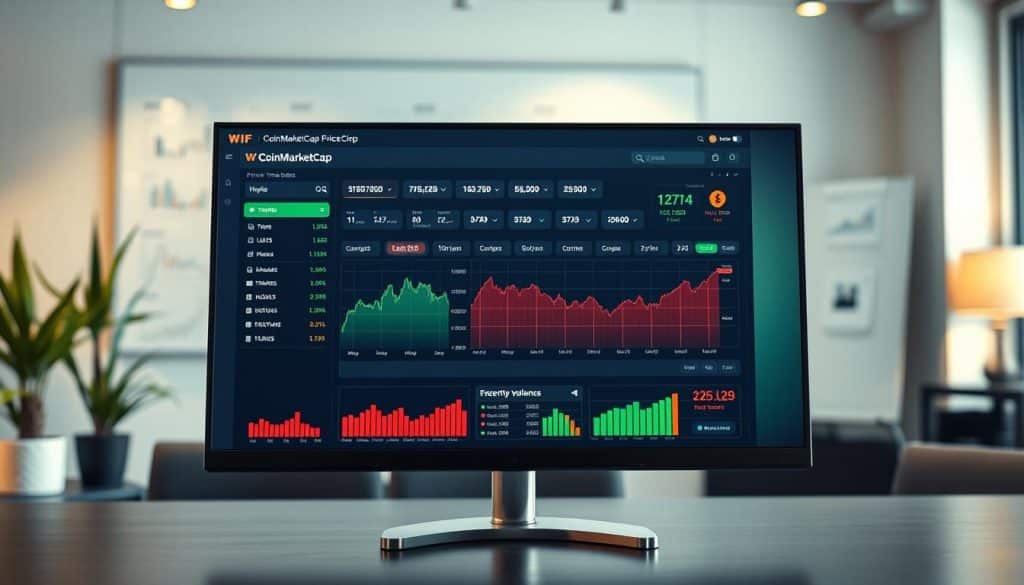
Here’s something that caught me off guard: dogwifhat cryptocurrency jumped into the top 50 tokens by market cap within months of launch. It pulled in trading volumes that rival projects around for years. I almost scrolled past WIF on CoinMarketCap at first.
Another dog meme coin? Seemed like we’d been there, done that. But the numbers made me pause and dig deeper.
This guide walks you through essential meme coin predictions data for tracking wif on CoinMarketCap. I’ve made mistakes jumping into tokens without proper research. So I’m breaking down real-time metrics that actually matter.
Price movements, holder statistics, and trading pairs give you context beyond the hype. We’re not doing the typical pump-piece here. This is practical stuff about using CoinMarketCap’s tools to understand where this token stands.
You’ll learn how to read the data without getting lost in the noise.
Key Takeaways
- WIF achieved top 50 market cap ranking faster than most established tokens, demonstrating significant community momentum
- CoinMarketCap provides real-time price tracking, trading volume data, and holder statistics essential for informed decision-making
- Understanding market cap rankings helps contextualize WIF’s position relative to other meme coins and established cryptocurrencies
- Trading pair analysis reveals liquidity depth and exchange availability critical for entry and exit strategies
- Historical price charts on CoinMarketCap identify pattern recognition opportunities and volatility trends
- Holder distribution metrics indicate centralization risks and community engagement levels
Introduction to WIF CoinMarketCap
Let’s establish what we’re dealing with when we talk about WIF. The relationship between this meme coin WIF and CoinMarketCap creates the foundation for tracking performance. I’ve spent countless hours navigating these platforms.
Understanding both components separately makes the combined picture much clearer. The cryptocurrency landscape changes rapidly. Having reliable tracking tools is essential for making informed decisions.
What is WIF?
Dogwifhat represents something genuinely interesting about modern cryptocurrency culture. It’s a Solana-based token that emerged from community creativity rather than venture capital backing. The name comes from a viral meme of a dog wearing a knitted hat.
This sounds absurd until you recognize how powerful shared cultural references become in digital communities. What sets dogwifhat cryptocurrency apart from thousands of other tokens? It’s the transparency about what it is.
There’s no pretense about revolutionizing finance or solving complex technical problems. Instead, it’s a community-driven project built on Solana’s fast, low-cost blockchain infrastructure.
The technical specifications matter here. WIF operates on Solana, which means transactions process quickly compared to Ethereum-based tokens. I’ve noticed this speed difference when moving funds between exchanges.
The token launched without presales or team allocations. This created what some call a “fair launch” environment. Everyone started from the same position.
Whether that translates to long-term value remains an open question. However, the approach generated significant community buy-in from day one.
Here’s what makes dogwifhat cryptocurrency tracking particularly relevant: the token gained substantial market capitalization despite its meme origins. At various points, it’s ranked among the top meme coins by market cap. This means it’s traded on major exchanges and tracked by serious investors.
Overview of CoinMarketCap
CoinMarketCap functions as the industry’s central nervous system for cryptocurrency data. I remember feeling overwhelmed when I first opened the site—numbers everywhere, charts updating constantly. But once you understand the architecture, it becomes an invaluable research tool.
The platform aggregates data from hundreds of exchanges simultaneously. For meme coin WIF specifically, this means you’re seeing the composite picture. You’re not seeing one exchange’s perspective but rather how the token trades across the entire ecosystem.
That distinction matters more than most beginners realize.
CoinMarketCap organizes cryptocurrency information into distinct sections. Each serves a specific purpose for traders and researchers:
- Markets tab: Shows where the token trades, including centralized exchanges (CEX), decentralized exchanges (DEX), spot markets, perpetual contracts, and futures options
- Holder information: Displays wallet distribution data, helping you understand if ownership is concentrated or distributed
- News feed: Aggregates relevant news articles and announcements about the specific cryptocurrency
- Similar coins: Compares the token with others in the same category, providing context for relative performance
The data refresh rates vary depending on exchange reporting speeds. Some platforms push updates every few seconds. Others might lag by several minutes.
I’ve learned to cross-reference between CoinMarketCap and individual exchanges when timing matters for trades.
Here’s a comparison of what CoinMarketCap provides versus individual exchange data for tracking dogwifhat cryptocurrency:
| Data Type | CoinMarketCap | Individual Exchange | Advantage |
|---|---|---|---|
| Price Data | Aggregated average across all exchanges | Exchange-specific pricing | CoinMarketCap shows market consensus |
| Trading Volume | Combined volume from multiple sources | Platform-specific volume only | CoinMarketCap reveals total market activity |
| Market Pairs | All trading pairs across platforms | Limited to exchange offerings | CoinMarketCap shows complete options |
| Historical Data | Comprehensive long-term records | Platform launch date forward only | CoinMarketCap provides broader context |
| Supply Metrics | Circulating and total supply tracking | Not typically provided | CoinMarketCap offers fundamental analysis data |
The platform’s real strength lies in consolidation. Rather than visiting multiple exchanges to piece together WIF’s performance, you get a unified dashboard. The time savings alone justify using it as your primary research starting point.
I’ve found the exchange comparison feature particularly useful. CoinMarketCap lists all platforms trading meme coin WIF with their respective volumes and prices. Occasionally, you’ll spot price discrepancies—arbitrage opportunities—where the token trades for slightly different amounts on different exchanges.
These gaps usually close quickly, but they exist.
The holder distribution data deserves attention too. For dogwifhat cryptocurrency, seeing how many wallets hold the token matters. Understanding what percentage the top holders control gives you insight into potential price manipulation risks.
Highly concentrated ownership can mean dramatic price swings when large holders decide to sell.
One limitation I always mention: CoinMarketCap relies on exchanges reporting accurate data. Not all platforms have equal verification standards. Some have been caught inflating volume numbers in the past.
The site has implemented measures to address this, including their exchange ranking system. However, perfect accuracy remains elusive in this space.
Current Price and Market Stats
Market data for WIF shows traders where the token stands right now. These statistics form the backbone of informed trading decisions in the volatile meme coin sector. Understanding price, market cap, and volume gives you the complete picture.
The numbers on CoinMarketCap come from dozens of exchanges using specific methodologies. They reflect actual market conditions. For WIF, this means getting a consolidated view of trading activity across multiple platforms.
Real-Time Price Tracking
The WIF token price updates constantly throughout the trading day. CoinMarketCap uses a volume-weighted average price calculation. Exchanges with higher trading activity have more influence on the displayed figure.
The refresh rate typically runs between 30 seconds to two minutes. That slight lag rarely matters for position trading or longer-term holds. Day traders trying to catch specific entry points need to understand this delay.
CoinMarketCap pulls order book data and recent trade history from each connected exchange. It calculates the weighted average based on trading volume. It’s not a simple arithmetic mean—the math favors platforms where actual trading happens.
Market Capitalization Overview
The WIF crypto market cap tells you the token’s total market value. This metric multiplies the current price by the circulating supply. It excludes locked tokens and coins not yet released into active trading.
Market capitalization provides context for comparison. A token priced at $0.001 with a $500 million market cap sits in a different league. The WIF coin ranking on CoinMarketCap reflects this market cap position relative to other cryptocurrencies.
WIF’s ranking fluctuates based on broader market conditions and community-driven events. Meme coins show high volatility in their market cap rankings. Their value derives heavily from social sentiment rather than underlying utility.
If WIF has 1 billion tokens in circulation and the current WIF token price is $0.0025, the market cap equals $2.5 million. That figure gets recalculated continuously as price changes. Supply changes less frequently, typically when new tokens unlock or burning mechanisms reduce the circulating amount.
Trading Volume Insights
Trading volume answers the question: How much actual buying and selling is happening right now? CoinMarketCap displays this as 24-hour volume. It shows the total dollar value of WIF that changed hands across all tracked exchanges.
High volume combined with price increases signals genuine buying pressure and strong market interest. This pattern happens when WIF catches attention on social media. High volume during price drops indicates serious selling pressure—people are actively exiting positions.
Low volume regardless of price direction means the market isn’t paying much attention to WIF. Prices can move on very little actual trading activity. This creates both opportunities and risks depending on your position and strategy.
CoinMarketCap breaks down volume by exchange. You can see where the majority of trading happens. Concentrated volume on one or two exchanges might indicate wash trading or artificial activity.
| Market Indicator | What It Measures | Why It Matters for WIF | Typical Update Frequency |
|---|---|---|---|
| Current Price | Volume-weighted average across exchanges | Primary entry/exit reference point for all traders | 30-120 seconds |
| Market Capitalization | Price × circulating supply | Shows WIF’s relative size and WIF coin ranking position | Continuous with price changes |
| 24h Trading Volume | Total dollar value traded in 24 hours | Indicates actual market activity and liquidity levels | Rolling 24-hour window |
| Volume Change % | Percentage increase or decrease from previous period | Reveals shifting interest and momentum changes | Updated with volume data |
The volume change percentage provides valuable context. A -22% volume drop might seem concerning initially. But if the previous day had unusually high activity, the decrease could represent normalization.
Check price, market cap, and volume together rather than in isolation. The WIF token price might look attractive. But if the WIF crypto market cap sits at inflated levels and volume is declining, that price might not hold.
CoinMarketCap also displays supplementary statistics like fully diluted valuation. This assumes all tokens eventually enter circulation. For WIF, comparing the current market cap to FDV shows potential dilution risk if significant token unlocks are scheduled.
Price Graph and Historical Data
Charts tell stories that numbers alone can’t convey. WIF’s price history is no exception. The visual representation gives you context that raw data simply can’t provide.
The graph shows you momentum and sentiment shifts. It reveals those crucial moments when everything changed for the token. Understanding historical data isn’t just about looking backward—it’s about recognizing patterns that might repeat.
For dogwifhat market analysis, the price graph becomes your primary tool. It helps you make informed decisions rather than emotional ones.
Interactive Price Chart
The interactive price chart on CoinMarketCap offers more functionality than most people realize. You can zoom in and out across different timeframes. Options include 1 day, 7 days, 1 month, 3 months, or the complete all-time view.
Each perspective reveals different insights about price behavior. Start with the all-time view to understand the token’s complete journey. Then zoom into shorter timeframes to spot recent patterns and trends.
The interactive feature lets you hover over specific dates. You can see exact prices at those moments. This helps tremendously when correlating price movements with news events or announcements.
CoinMarketCap displays candlesticks in the detailed view. This gives you significantly more information than a basic line graph. Each candlestick shows you the opening price, closing price, and the high and low points.
This data matters because it reveals buying and selling pressure at different price levels.
The chart is the canvas upon which market psychology is painted, showing the eternal struggle between fear and greed.
The chart interface isn’t as advanced as dedicated platforms like TradingView. However, it provides enough information for most tracking purposes. You get the essential data without overwhelming complexity.
Historical Price Trends
Historical price trends for dogwifhat market analysis reveal patterns that repeat across crypto markets. Like most meme coins, WIF experienced an explosive initial run after launch. This was followed by the inevitable correction as early investors locked in profits.
What happens after that initial cycle tells you more about the token’s staying power. Does the token establish new support levels after corrections? Does it trend upward during broader market rallies, or does it sit stagnant?
The historical data shows these cycles clearly. While past performance doesn’t guarantee future results, patterns do tend to repeat in crypto.
Several key trends emerge when studying the WIF token price over time:
- Recovery patterns after major corrections show the strength of buyer interest at lower levels
- Correlation with Solana’s price movements indicates ecosystem dependency
- Volume patterns during rallies reveal whether moves are sustainable or driven by speculation
- Support and resistance levels that form repeatedly become psychologically important price points
These trends help you understand the token’s staying power. The historical data doesn’t lie about community commitment and market interest over time.
Major Price Movements
Major price movements are marked by volume spikes on the chart. CoinMarketCap’s interface makes these pretty obvious. You’ll see vertical volume bars below the price chart that shoot upward during significant moves.
These spikes indicate when something important happened. This is true even if you don’t immediately know what that something was.
For WIF, these major movements often coincide with social media trends. They also align with exchange listings or broader Solana ecosystem news. The chart lets you identify these moments.
If you’re curious, you can cross-reference dates with the news section. This helps you understand what drove the movement.
Technical analysts use specific indicators to predict and understand these movements. The table below shows the key technical indicators commonly applied to dogwifhat market analysis:
| Technical Indicator | Purpose | Typical Value Range | Signal Interpretation |
|---|---|---|---|
| 30-Day SMA | Short-term trend direction | Varies with price | Price above indicates bullish momentum |
| 200-Day SMA | Long-term trend direction | Varies with price | Golden cross signals potential rally |
| RSI (Relative Strength Index) | Overbought/oversold conditions | 0-100 scale | Below 30 oversold, above 70 overbought |
| MACD Histogram | Momentum strength and direction | Positive or negative values | Crossovers indicate trend changes |
| Fibonacci Retracement | Potential support/resistance levels | Key levels at 50% and 78.6% | Price often bounces at these levels |
Understanding these technical indicators helps you make sense of price movements. For instance, when RSI reaches 45.71, it suggests neutral conditions. This middle ground often precedes directional moves as the market decides its next path.
The Fibonacci retracement levels are particularly interesting. They represent psychological price points where traders expect support or resistance. When the WIF token price approaches these levels, you often see increased trading activity.
Technical analysis isn’t fortune-telling, but it gives you a framework. The patterns on these charts represent thousands of traders making decisions. Reading those patterns takes practice, but the historical data provides an excellent learning laboratory.
WIF Coin Trading Analysis
WIF trading volume shows where market momentum lives and which platforms traders trust most. Analyzing trading patterns gives real insight into market operations beyond price movements. Understanding where people trade and what pairs they use ensures smooth execution and good liquidity.
The dogwifhat market shows distinct patterns across different trading venues and pairs. Volume distribution reveals trader preferences and helps identify the best entry points. This section breaks down the practical trading landscape for WIF coin.
Most Active Trading Pairs
WIF/USDT represents the dominant trading pair for dogwifhat across most exchanges. This pairing gives direct exposure to dollar-equivalent pricing without crypto-to-crypto volatility. USDT pairs offer the tightest spreads and deepest liquidity pools.
The WIF/SOL pairing makes sense for Solana ecosystem participants. Since WIF operates on Solana’s blockchain, this direct pair eliminates conversion steps. If you hold SOL and want WIF exposure, you save on transaction fees and execution time.
WIF/USDC provides another stablecoin option for traders who prefer Circle’s regulated backing. The volume here runs lower than USDT pairs, but stability remains comparable. Some traders split positions between both stablecoin pairs for risk distribution.
Trading pair selection affects your overall strategy more than people realize. Each pair carries different liquidity profiles and fee structures. The most liquid pairs deliver better execution prices, especially during volatile market conditions.
Liquidity is the lifeblood of any trading market. Without sufficient volume, even the best trading strategy fails on execution.
Where to Trade WIF Coin
Centralized exchanges dominate the WIF trading volume landscape. Binance, OKX, and Gate.io provide the highest liquidity and fastest order execution. These platforms handle large orders without significant price slippage.
Centralized exchange platforms offer advantages for active traders. The order books show real depth, and market orders execute instantly. Advanced features like stop-losses and limit orders function reliably during high volatility periods.
Decentralized exchanges serve a different trading philosophy. Raydium and Orca operate as Solana-native DEX platforms where you maintain custody throughout trades. You’ll need compatible wallets like Phantom or Solflare to connect.
The DEX experience requires more technical knowledge but delivers true ownership. Your tokens never leave your wallet during the swap process. This matters if you’re uncomfortable with exchange custody or operate in jurisdictions with regulatory concerns.
KuCoin and Binance have issued trading notifications for WIF, indicating significant platform support. These exchanges provide direct fiat on-ramps in many regions. The infrastructure around WIF continues expanding as trading interest grows.
Platform choice depends on your priorities. Centralized venues win on speed and liquidity, while decentralized options prioritize control and privacy. Many experienced traders use both types depending on trade size and market conditions.
Volume Distribution Across Exchanges
The WIF trading volume breakdown reveals interesting market structure patterns. Centralized exchanges capture approximately 65-70% of total volume during normal market conditions. This concentration shows where institutional and high-frequency traders operate.
Decentralized exchange volume spikes during periods of regulatory uncertainty or platform concerns. DEX volume percentages jump from 30% to over 45% when centralized platforms face scrutiny. This shift demonstrates the market’s flexibility in response to external pressures.
| Exchange Platform | 24hr Volume Share | Primary Trading Pair | Platform Type |
|---|---|---|---|
| Binance | 28.5% | WIF/USDT | CEX |
| OKX | 18.3% | WIF/USDT | CEX |
| Raydium | 15.7% | WIF/SOL | DEX |
| Gate.io | 12.4% | WIF/USDT | CEX |
| Orca | 8.9% | WIF/USDC | DEX |
Market structure analysis shows the split between spot, perpetual, and futures trading. Spot trading accounts for roughly 55% of WIF trading volume, while perpetual contracts capture 35%. Traditional futures make up the remaining 10%.
This distribution indicates that most traders prefer direct token ownership over leveraged positions. Volume concentration matters when planning large trades.
If a single exchange represents 25% of daily volume, executing a significant position there creates less market impact. Spreading orders across multiple venues reduces your footprint but increases complexity.
Weekly dogwifhat market analysis tracks these volume shifts. Sudden changes in exchange distribution often precede price movements. Rapid volume migration between platforms signals something happening behind the scenes.
Understanding WIF trading volume patterns helps time entries and exits more effectively. The data lives on CoinMarketCap’s markets tab, updated in real-time. Check this before every significant trade because liquidity conditions change faster than most people realize.
WIF Coin Predictions and Forecasts
Predicting where WIF is headed brings many opinions but few certainties. Nobody knows what’s going to happen with cryptocurrency prices, including WIF. Anyone claiming definitive answers is either selling something or misunderstands how markets work.
Traders and analysts use actual methodologies to make educated guesses. Understanding these methods helps you evaluate WIF price prediction forecasts. You’ll encounter these forecasts across social media and trading platforms.
Technical Analysis and Price Targets for 2024
Technical analysts examining WIF look at several key indicators to project price movements. These approaches aren’t crystal balls. They provide frameworks for thinking about possibilities.
The most common technical indicators traders watch include:
- RSI (Relative Strength Index) – Currently sitting at 45.71 for similar meme coins, this neutral reading suggests neither overbought nor oversold conditions
- MACD signals – These momentum indicators help identify trend reversals and continuation patterns
- Fibonacci retracement levels – Traders use these percentage levels (23.6%, 38.2%, 50%, 61.8%, 78.6%) to identify potential reversal points
- Support and resistance identification – Key price levels where buying or selling pressure historically concentrates
WIF establishes a clear support level and respects it multiple times. Technical analysts might predict continued upward movement. This only works if broader market conditions remain favorable.
The Crypto Fear & Greed Index currently registers at 25 out of 100. This indicates extreme fear in the market. Fear dominates, so even positive news doesn’t move prices much.
During greed phases, bad news gets ignored. The altcoin season index sits at 23 out of 100. This low reading suggests Bitcoin dominance rather than altcoin momentum.
These sentiment readings suggest we’re potentially near a market bottom. For WIF price prediction in 2024, this matters more than you might think.
Fundamental analysis for meme coins works differently than traditional assets. There’s no earnings report to scrutinize. Analysts examine community growth metrics, holder distribution patterns, and exchange listings.
| Analysis Method | Key Metrics | Reliability Factor | Best Used For |
|---|---|---|---|
| Technical Analysis | RSI, MACD, Fibonacci levels | Moderate for short-term | Entry/exit timing |
| Sentiment Indicators | Fear & Greed Index, social volume | High for meme coins | Market cycle positioning |
| On-Chain Analysis | Holder distribution, whale activity | Moderate for risk assessment | Understanding concentration |
| Comparative Models | Market cap ratios to similar coins | Low for specifics | Potential upside scenarios |
Expert Perspectives and Analytical Frameworks
Expert opinions on WIF vary wildly depending on methodology and potential conflicts of interest. Crypto researchers see WIF as part of the broader meme coin cycle. This cycle tends to follow Bitcoin’s movement with amplified volatility.
Some analysts create comparative models based on market cap analysis. If WIF captured a certain percentage of DOGE’s market cap, the price would reach a specific target. These models are highly speculative but give you a framework for understanding potential upside.
The challenge is separating genuine analysis from promotional content. Many “expert predictions” are really marketing for exchanges or projects with vested interests. Here’s what to look for:
- Specific reasoning tied to data points rather than vague optimism
- Acknowledgment of downside risks and failure scenarios
- Transparent methodology explaining how conclusions were reached
- No guarantees or certainty language that oversells the prediction
Crypto trading firms focus on Solana’s ecosystem growth as a positive catalyst. The argument makes sense—a thriving ecosystem typically lifts all projects within it. But correlation isn’t causation, and ecosystem growth doesn’t guarantee individual token performance.
Some researchers emphasize holder distribution analysis. If WIF tokens are concentrated in just a few wallets, that creates manipulation risk. Broadly distributed holdings suggest healthier long-term prospects, though this alone doesn’t predict price direction.
Predictions based purely on historical meme coin cycles argue these coins follow predictable boom-bust patterns. Timing entries near cycle lows offers the best risk-reward ratio. Each cycle has unique characteristics that challenge pattern repetition.
The most honest expert analyses acknowledge that meme coin prices are driven more by psychology than fundamentals. This makes traditional valuation methods less applicable. Understanding crowd behavior, social media trends, and broader crypto market sentiment becomes more relevant.
For 2024 specifically, predictions range from bearish forecasts to bullish projections. The wide range tells you something important. There’s no consensus because the variables affecting WIF are numerous and constantly shifting.
Tools for Tracking WIF Coin
Most people check wif coinmarketcap sporadically. Dedicated tracking tools provide consistent monitoring needed for informed decisions. The difference between reactive checking and proactive management comes down to using specialized software.
Proper monitoring systems eliminate constant anxiety about checking prices. These tools automatically track your positions. You won’t need to wonder if you should log in.
Comprehensive tracking tools consolidate data from multiple sources into unified dashboards. This becomes valuable when holding WIF across different exchanges or wallets. Logging into five separate platforms to calculate your total position gets old fast.
Portfolio Management Solutions
Portfolio trackers represent the most practical tool for anyone holding WIF. CoinMarketCap offers built-in portfolio tracking where you input your holdings. The platform automatically calculates your current position value and profit percentage.
The real advantage here is consolidation. Your WIF tokens might be split between Binance and a Phantom wallet. A portfolio tracker gives you one unified view instead of mental math.
I use CoinMarketCap’s tracker for quick reference checks. Third-party applications provide deeper analysis. The wif coinmarketcap platform provides several valuable features beyond basic tracking:
- Real-time data loading that updates prices automatically without manual refreshing
- Holder tracking capabilities showing distribution patterns across wallet addresses
- News aggregation pulling relevant WIF announcements and market updates
- Similar coin comparison features that identify tokens with comparable characteristics
Other popular portfolio trackers bring different strengths to the table. CoinGecko serves as CoinMarketCap’s main competitor with similar functionality. Delta and CoinStats have gained followings for their mobile-first designs.
The best portfolio tracker isn’t necessarily the one with the most features—it’s the one you’ll actually use consistently to monitor your positions and make data-driven decisions.
WIF is built on Solana. You can track holdings directly through blockchain explorers like Solscan or Solana Beach. These platforms show real-time balances by entering your wallet address.
On-chain tracking eliminates the need to manually input transaction data. The transparency provides verification that exchange-displayed balances are accurate.
| Tracker Platform | Key Strengths | Best Use Case | Cost Structure |
|---|---|---|---|
| CoinMarketCap | Real-time data, news integration, holder tracking | Quick reference and general monitoring | Free with premium options |
| CoinGecko | Alternative data sources, community features | Cross-referencing CMC data | Free with API limits |
| Delta | Mobile-optimized, customizable alerts | On-the-go tracking | Freemium model |
| CoinStats | Exchange API connections, tax reporting | Automated portfolio sync | Subscription tiers |
| Solscan | On-chain verification, transaction history | Wallet-level accuracy | Completely free |
Advanced Charting Platforms
Charting tools go several levels deeper than wif coinmarketcap provides. TradingView stands as the gold standard here. Technical analysts spend their time on it because it offers hundreds of indicators.
You can pull up WIF on TradingView and apply moving averages. Add Bollinger Bands, RSI, MACD, and Fibonacci retracements. The free version has limitations but is still incredibly powerful compared to basic charts.
I’ve found Dextools particularly helpful for tracking decentralized exchange activity. Significant WIF volume happens on Solana DEXs. Dextools shows real-time trades and wallet tracking for large holders.
For price alerts, I use a combination approach. CoinMarketCap’s built-in alert feature handles major price thresholds. Telegram bots notify me when WIF crosses specific levels or volume spikes.
These notification systems sound like overkill until you miss a major price movement. Setting up comprehensive alerts takes maybe fifteen minutes. It potentially saves you from missing significant trading opportunities.
I configure alerts at psychological price levels where trading activity typically increases. I also set them at technical indicator crossover points. These signal potential trend changes.
The combination of portfolio trackers and advanced charting tools creates a complete system. You don’t need every tool mentioned here. Having at least one solid portfolio tracker significantly improves your ability to make informed decisions.
Investment Strategies for WIF Coin
Your approach to WIF investment potential determines your returns, stress levels, and time commitment. I’ve tried multiple strategies with meme coins over the years. Each comes with distinct advantages and challenges you need to understand before investing.
The difference between long-term holding and active trading isn’t just about tactics. It’s about matching strategy to your personality, available time, and risk tolerance.
Meme coins like WIF behave differently from traditional investments. The volatility is extreme, and sentiment-driven price swings are unpredictable. The long-term survival rate is honestly pretty low.
But the coins that do succeed can deliver worthwhile returns. This works for those who approach it strategically rather than emotionally.
Long-Term Holding vs. Day Trading
The first major decision you’ll face is whether to hold WIF or trade it. Long-term holding—called “HODLing” in crypto culture—means buying WIF and keeping it for months or years. This approach worked spectacularly for early DOGE and SHIB holders.
The case for holding WIF long-term depends on your belief in Solana’s continued growth. It also depends on the staying power of meme coin culture. I’ve held positions that dropped 40% within weeks.
The psychological challenge of not panic-selling is real. You need genuine conviction about why WIF specifically will be among the survivors.
The advantages of long-term holding include minimal transaction fees and no constant monitoring. You also get potential tax benefits if you hold for over a year. The downside is watching your portfolio value swing wildly without being able to act.
For better insights on memecoin strategies, understanding market cycles becomes essential.
Day trading WIF takes the opposite approach—capitalizing on volatility rather than enduring it. Meme coins can swing 10-20% in a single session on moderate volume. This creates opportunities for traders who can read momentum and sentiment quickly.
I tried day trading meme coins for a few months and found it exhausting. The stress and time commitment barely justified the modest profits I made.
Successful day traders typically use technical indicators on short timeframes—5-minute or 15-minute charts. They set tight stop-losses and take profits quickly rather than waiting for maximum gains. The minimal transaction fees on Solana make day trading WIF more feasible than on Ethereum.
The challenge with day trading is that it requires constant attention and quick decision-making. It also requires emotional discipline to cut losses without hesitation. Most people don’t have the temperament or available time to do this successfully.
| Strategy Factor | Long-Term Holding | Day Trading | Best For |
|---|---|---|---|
| Time Commitment | Minimal monitoring needed | Requires constant attention | Holding suits busy schedules |
| Stress Level | High during major drawdowns | High from rapid decisions | Holding if you can ignore charts |
| Profit Potential | Massive if coin survives | Consistent small gains possible | Depends on conviction vs. skill |
| Transaction Costs | Very low (one-time fees) | Accumulates with frequency | Holding minimizes costs |
| Success Requirements | Conviction and patience | Technical skill and discipline | Match to your personality |
Risk Management Techniques
Risk management isn’t optional with meme coins—it’s the difference between calculated speculation and reckless gambling. The most fundamental rule I follow is never investing more than I can afford to lose. With WIF and similar tokens, that’s not hypothetical caution but a realistic possibility.
Position sizing matters enormously when evaluating WIF investment potential. Even if you’re bullish on the token, it probably shouldn’t represent 50% of your crypto portfolio. I use a personal rule where meme coins never exceed 10-15% of my total crypto allocation.
This approach means that even if WIF goes to zero, it won’t devastate my overall financial situation. I’ve watched people go too heavy into meme coins during euphoric market phases. They suffered significant losses when sentiment shifted.
Stop-loss orders automatically sell your WIF if the price drops to a predetermined level. These work better for day trading than long-term holding because meme coin volatility can trigger stops prematurely. The tricky part is setting the stop-loss far enough away to avoid false triggers.
I learned this lesson the hard way when tight stop-losses on a meme coin got triggered. My position sold at the bottom before it recovered 30% within hours. Now I use wider stops or skip them entirely for long-term positions.
Key risk management practices include:
- Diversification within crypto—holding multiple assets rather than concentrating everything in WIF reduces single-token risk
- Profit-taking discipline—when a position doubles, taking out your initial investment lets the rest ride as pure profit
- Emotional detachment—making decisions based on predetermined criteria rather than fear or greed
- Regular rebalancing—adjusting position sizes as values change to maintain target allocations
- Exit strategy planning—knowing in advance what price levels or conditions would trigger a sale
Taking profits along the way rather than trying to time the perfect top helps lock in gains. I’ve watched paper profits evaporate too many times by being greedy. Now when a position doubles, I typically take out my initial investment.
This approach eliminates emotional attachment since what remains is pure profit with zero cost basis.
The PEPE security incident in 2024 illustrated how quickly meme coin situations can deteriorate. This caused market-wide risk aversion that affected tokens like WIF. Understanding key support and resistance levels helps with decision-making during these volatile periods.
Risk management for meme coins also means staying informed about broader market conditions. Meme coins typically suffer disproportionate selling pressure during Bitcoin corrections or regulatory concerns. Reducing exposure during these periods can preserve capital for reinvestment when conditions improve.
Frequently Asked Questions about WIF
I’ve tracked WIF for months and noticed certain questions surface repeatedly. These aren’t random curiosities—they reflect genuine concerns every potential investor should address. I’m tackling the most important ones head-on with straight answers.
The FAQ format works well because meme coin WIF attracts seasoned traders and complete newcomers. Each group brings different knowledge levels and concerns. Honest, practical answers serve everyone better than promotional hype or vague reassurances.
Common Questions About Investing in WIF
Is WIF a good investment? This tops my inbox every week. My answer stays consistent—it depends entirely on your risk tolerance and investment goals. WIF is highly speculative with significant downside risk but also substantial upside potential.
It’s not appropriate for conservative investors or anyone who can’t afford losses. I treat meme coin WIF as a small percentage of my crypto portfolio. That position size lets me participate in gains without jeopardizing my financial security.
What makes WIF different from other meme coins? Honestly? Not much in terms of utility or underlying technology. It’s a Solana-based token with a community rallying around the dogwifhat concept. The differentiator is community strength and staying power.
Some meme coins fade within weeks. Others, like Dogecoin, persist for years. WIF falls somewhere in the middle currently—established enough to have liquidity but young enough that its trajectory remains uncertain.
How much could WIF be worth? Nobody knows with any certainty. Anyone providing specific price targets years into the future is guessing, not analyzing. I can run theoretical calculations, but those are “if” scenarios, not predictions.
The crypto market has humbled me enough times that I’ve stopped making confident price predictions. What I can tell you is that meme coin WIF needs sustained community engagement and favorable market conditions.
Is WIF safe? This question has multiple dimensions. In terms of smart contract security, the Solana token program is generally secure and well-audited. But “safe” in the investment sense? Absolutely not.
Beyond investment risk, security considerations keep me vigilant. The recent PEPE meme coin website hack demonstrated how external vulnerabilities threaten even established tokens. Hackers compromised the website and redirected visitors to wallet-draining malware.
The smart contract remained secure, but users still lost funds through phishing. Exchange warnings matter too. Both KuCoin and Binance have issued advisories about meme coin volatility and manipulation risks.
I always verify contract addresses and use official links exclusively. I remain suspicious of offers that seem too good to be true.
What’s the total supply of WIF? This technical question directly impacts long-term value potential. The tokenomics shape price dynamics fundamentally. I always check CoinMarketCap’s supply data before investing in any token.
Understanding whether large holders control significant percentages helps me assess manipulation risk. Tokens with concentrated ownership can experience dramatic price swings when whales decide to sell.
Step-by-Step Guide to Purchasing WIF
The buying process varies depending on whether you choose a centralized or decentralized exchange. I’ve used both methods successfully, and each has distinct advantages. Let me walk you through both approaches with the same detail I’d give a friend.
Centralized Exchange Method:
- Select an Exchange: Check CoinMarketCap’s markets section for current WIF listings. Major platforms like Binance, OKX, and Gate.io typically offer WIF trading pairs. I prefer exchanges with high trading volume because they provide better liquidity and tighter spreads.
- Complete KYC Verification: Create your account and submit identity documents for Know Your Customer verification. This process sometimes takes several days, so plan accordingly. I know KYC feels invasive, but regulated exchanges require it for legal compliance.
- Deposit Funds: Transfer cryptocurrency you already own (USDT or Bitcoin work well) or deposit fiat currency through bank transfer or card payment. Each exchange offers different funding options with varying fees and processing times.
- Execute Your Trade: Navigate to the WIF trading pair (usually WIF/USDT), then choose between a market order (executes immediately at current price) or limit order (executes only when price reaches your specified level). I typically use limit orders to control my entry price.
- Secure Your Assets: The WIF tokens appear in your exchange wallet after purchase. For enhanced security, I strongly recommend transferring them to a personal wallet rather than leaving them on the exchange long-term.
Decentralized Exchange Method on Solana:
- Set Up a Wallet: Install a Solana-compatible wallet like Phantom, Solflare, or Backpack. Secure your seed phrase immediately—if you lose it, your funds become permanently unrecoverable. I write mine on paper and store it in a safe location, never digitally.
- Acquire Solana (SOL): You’ll need SOL both for swapping to WIF and for paying transaction fees. Purchase it through a centralized exchange or on-ramp service, then send it to your wallet address. Always send a small test amount first to confirm the address is correct.
- Connect to a DEX: Visit Raydium or Orca (popular Solana DEXs), then connect your wallet. The interface prompts you to approve the connection—verify you’re on the legitimate website before approving.
- Swap for WIF: Find the WIF/SOL trading pair, enter your desired swap amount, review the transaction details including fees and slippage, then confirm. The meme coin WIF tokens appear in your wallet within seconds.
The DEX route provides more privacy and direct control. It requires comfort with self-custody and blockchain transactions. I prefer it for larger purchases because it eliminates exchange counterparty risk.
Critical Security Practices: Regardless of which method you choose, always double-check contract addresses against official sources. Start with a small test transaction if you’re new to the process. Never share your seed phrase or private keys with anyone for any reason.
I’ve seen too many people lose funds to preventable mistakes. Taking extra time to verify addresses protects you from common theft methods. The meme coin WIF community can’t help you recover funds sent to the wrong address.
The Role of Community in WIF Coin
I’ve watched countless meme coins rise and fall. The pattern is always the same—strong communities survive, weak ones vanish. For dogwifhat cryptocurrency, this reality is even more pronounced because there’s no underlying technology or business model to evaluate.
The community is the value proposition. Without engaged holders who actively promote, create content, and maintain interest, WIF becomes just another forgotten token. A dog-themed logo alone won’t keep a coin alive.
The difference between WIF and failed meme coins isn’t luck. It’s community strength and the ability to maintain momentum even during market downturns. Monitoring community health gives you insights that price charts simply can’t provide.
Community Engagement Across Multiple Platforms
Community engagement for dogwifhat cryptocurrency happens across several platforms. Each platform serves a different purpose in the ecosystem. Twitter (now X) is where the most visible activity occurs—memes, price commentary, and project updates flow constantly.
I’ve learned that quality matters more than quantity when evaluating these communities. The real question is whether people are genuinely enthusiastic or just bot accounts and paid promoters. For WIF, I’ve noticed fairly organic community behavior.
Members create genuinely funny content without the desperate, overly promotional tone that plagues struggling projects. The self-aware humor resonates with crypto natives who are tired of projects promising to revolutionize everything. This authenticity is part of what makes dogwifhat cryptocurrency work as a long-term hold.
Telegram and Discord channels host more substantive interactions. These platforms facilitate real-time discussions where community members share trading strategies, ask questions, and receive updates directly. I periodically lurk in WIF community channels to gauge sentiment and spot early warning signs.
A noticeably negative community mood often indicates decline before it shows up in price charts. Similarly, when active members start disappearing or conversation volume drops significantly, trouble usually follows within weeks.
Reddit communities around WIF vary considerably in quality. Some are echo chambers where any skepticism gets downvoted aggressively. Others have more balanced discussions that acknowledge both bullish and bearish perspectives honestly.
The useful community spaces are ones where people share actual analysis rather than just “to the moon” hype. Look for communities that track whale wallet movements, post about exchange listings or partnerships, and call out scams. These signal a mature community that will stick around.
Social Media Presence and Influencer Impact
Social media presence for dogwifhat cryptocurrency extends beyond just holder communities to include influencer attention. Crypto Twitter personalities with large followings can move meme coin prices significantly when they mention a token. I’ve seen WIF pump 20-30% within hours of a major influencer tweeting about it.
This creates both opportunity and risk that you need to understand. The pump is exciting if you’re already holding. But buying during an influencer-driven spike often means catching the top before a quick correction.
I’ve learned to be skeptical of sudden influencer interest, especially from personalities who promote multiple tokens frequently. This pattern suggests possible paid promotions rather than genuine conviction. The promotional nature becomes obvious when they never mention the token again after the initial spike.
More valuable than occasional influencer mentions is sustained attention from multiple independent voices. Several respected crypto commentators discussing dogwifhat cryptocurrency over weeks or months indicates genuine interest rather than coordinated promotion.
The organic social media presence builds gradually through community-created content. WIF holders who make memes, share analysis, and engage authentically create far more sustainable value than any paid influencer campaign. This grassroots approach has kept WIF relevant when other meme coins from the same period have completely disappeared.
Community governance, while less formal than DAO-structured projects, still matters for meme coins. Sometimes the WIF community rallies around specific initiatives—pushing for new exchange listings, organizing marketing campaigns, or creating community-funded projects. The community’s ability to coordinate and execute on these initiatives indicates strength and staying power.
Weak communities fracture quickly when prices drop and everyone blames each other. Strong communities use downturns to build and prepare for the next cycle. I’ve seen this pattern repeatedly across different projects.
The communities that survive bear markets are the ones that maintain engagement even when prices are down 70-80% from peak. They continue creating content, supporting each other, and building toward the next opportunity.
For dogwifhat cryptocurrency specifically, monitoring community health across these platforms gives you qualitative insights that pure price data doesn’t capture. High and organic community engagement often leads to price momentum. When engagement drops off, prices usually eventually reflect that decline in attention and enthusiasm.
Regulations and Compliance for WIF Coin
Regulations and compliance might sound boring compared to price charts and moonshot predictions. But they’re arguably the most important risk factor for WIF holders. I’ve watched perfectly healthy crypto projects lose 50% of their value overnight because of a single regulatory announcement.
The legal landscape changes fast. Meme coins exist in a particularly uncertain space.
Understanding how regulations affect your WIF holdings isn’t optional anymore. Exchanges can delist tokens with zero warning when regulators apply pressure. Your trading access can disappear instantly.
Even if you’re just holding and not actively trading, regulatory shifts can dramatically impact WIF crypto market cap. They can also affect your ability to exit positions when you need to.
The challenge with meme coins like WIF is clear. Regulators haven’t created clear rules specifically for them yet. We’re operating in a grey area that could shift in any direction.
Understanding Legal Aspects
The Securities and Exchange Commission has become increasingly aggressive about crypto enforcement over the past few years. Their primary concern is whether tokens qualify as securities under something called the Howey Test. This test asks whether there’s an investment of money in a common enterprise.
Most major cryptocurrencies have been scrutinized under this framework. Bitcoin and Ethereum have generally received passes because they’re sufficiently decentralized. But newer tokens face constant uncertainty about their classification.
For meme coins like WIF, the legal status gets murky. There’s no formal company structure making promises about future development. There’s no roadmap claiming that a team will create value for holders.
This might actually work in WIF’s favor. It’s hard to argue that holders are relying on “the efforts of others.” There’s no formal development team making promises.
But courts haven’t definitively ruled on pure meme coins yet. If the SEC decided to classify WIF as a security, exchanges would need to delist it immediately. This would eliminate most trading access and crash the WIF crypto market cap virtually overnight.
I don’t think this scenario is particularly likely for pure community-driven meme coins. But it’s a tail risk worth acknowledging.
Cryptocurrency is treated as property by the IRS, meaning every trade—including swapping SOL for WIF, or WIF for USDT—is a taxable event that generates capital gains or losses.
Tax implications represent another legal aspect most people completely overlook until tax season arrives. In the United States, every single trade you make creates a taxable event. If you bought SOL, swapped it for WIF, then later sold WIF for USDT, that’s two separate taxable transactions.
You need to calculate your cost basis and gains or losses for each one.
Centralized exchanges usually provide tax reports that help with this documentation. Decentralized exchanges generally don’t, which means you’re on your own to track everything. I learned this the hard way my first year actively trading.
I realized I had hundreds of taxable events to document manually. The IRS has been getting much more serious about crypto tax enforcement. Underpaying can result in penalties and interest.
International regulations vary dramatically by country. Some nations have banned cryptocurrency trading entirely. Others tax it heavily, while a few countries like El Salvador have created very favorable treatment.
If you’re outside the United States, your regulatory environment might be completely different. Staying compliant requires understanding your specific jurisdiction’s requirements.
Exchange-level compliance matters more than most traders realize. Centralized exchanges that list WIF must comply with KYC and AML regulations. That’s why they require identity verification before you can trade.
Exchanges sometimes face regulatory enforcement actions. They sometimes freeze withdrawals or restrict certain assets entirely. This leaves traders unable to access their holdings.
This happened repeatedly during the FTX collapse and the subsequent regulatory scrutiny across the industry. Using decentralized exchanges avoids some of these centralized points of failure. But DEXs have their own regulatory questions around whether they qualify as unregistered securities exchanges.
Impact of Regulations on Price
Regulatory announcements create immediate and often dramatic price movements. The entire market crashed within days after China banned crypto mining and trading in 2021. Assets often drop 20-40% on the news alone before any formal action happens.
Positive regulatory developments work the opposite way. Bitcoin ETF approvals or clear regulatory frameworks that reduce uncertainty tend to boost prices. This includes meme coins that benefit from increased overall interest and capital flow.
For WIF specifically, I see three main regulatory risk categories that could significantly impact the WIF crypto market cap. First, major exchanges could delist due to regulatory pressure. Second, stablecoin regulations could disrupt USDT or USDC, since most WIF trading happens in stablecoin pairs.
Third, broader Solana regulatory issues could affect all tokens built on the chain.
| Regulatory Risk | Probability | Potential Price Impact | Mitigation Strategy |
|---|---|---|---|
| Exchange Delisting | Moderate | 40-60% decline | Use multiple exchanges and DEX alternatives |
| Stablecoin Disruption | Low-Moderate | 30-50% decline | Monitor stablecoin regulatory news closely |
| Solana Chain Issues | Low | 50-70% decline | Diversify across multiple blockchain ecosystems |
| SEC Security Classification | Very Low | 70-90% decline | Stay informed on SEC enforcement patterns |
I monitor regulatory news not because I expect WIF to be directly targeted. Downstream effects of major regulatory actions impact meme coin markets even when they’re not the primary focus. A crackdown on major exchanges affects all tokens listed there.
New tax reporting requirements change trader behavior across the board.
The regulatory landscape remains uncertain enough that I treat it as a variable risk factor requiring periodic monitoring. Setting up news alerts for major regulatory developments and checking them weekly takes maybe 10 minutes. This can provide early warning of potential market-moving events.
Compliance isn’t just about following rules. It’s about understanding how regulatory changes create opportunities and risks. Traders who pay attention to regulatory trends can often anticipate market movements before they happen.
The Future of WIF Coin
I see opportunities emerging from Solana’s growth and the evolving meme coin sector. The WIF investment potential depends on community influence and broader market dynamics. Understanding this balance helps set realistic expectations while recognizing meme coins can surprise everyone.
The crypto market environment shows some challenging indicators right now. Bitcoin dominance sits at 58.65%, meaning capital concentrates in BTC rather than altcoins. The altcoin season index registers just 23 out of 100.
The Fear & Greed Index shows Extreme Fear at 25, reflecting overall market caution. These metrics matter because WIF’s performance correlates strongly with broader market sentiment. Risk appetite drives this token’s movement.
Internal Growth Catalysts and Community-Driven Development
Several growth opportunities exist within WIF’s ecosystem that could drive future value. Additional exchange listings on major platforms represent the most immediate catalyst. New exchanges expand trading accessibility and typically trigger price increases.
Integration into Solana ecosystem projects offers another path forward. If WIF joins DeFi protocols, NFT marketplaces, or gaming applications, it gains utility. Some meme coins have successfully evolved this way.
I’m honestly skeptical that utility additions matter much for meme coins. Successful ones typically win on brand and culture more than functionality. But these developments don’t hurt and might reduce volatility somewhat.
Partnership opportunities with other projects, brands, or influencers could expand awareness significantly. Community-driven initiatives give holders reasons to maintain positions beyond short-term trading. These developments depend entirely on community motivation and coordination.
External Market Forces and Solana’s Technical Evolution
The broader cryptocurrency market’s health directly impacts WIF’s trajectory. During bull markets, speculative assets like meme coins tend to outperform dramatically. Risk appetite increases and capital rotates into higher-reward opportunities.
Altcoin season represents peak speculation phase. During these periods, meme coins often see explosive growth as traders chase momentum. The current reading of 23 suggests we’re far from that environment.
Solana’s success matters enormously for WIF since it’s built on that blockchain. If Solana continues attracting developers, users, and capital, the entire ecosystem benefits. Solana has been expanding its DeFi ecosystem, NFT marketplaces, and consumer applications steadily.
The network has faced technical challenges in the past, including outages that damaged confidence. Solana’s development team is working on Firedancer, a new validator client. This blockchain technology upgrade makes Solana more competitive with other high-performance chains.
Cross-chain bridges, improved wallet interfaces, and better onboarding tools all indirectly benefit WIF. These innovations expand the potential user base for Solana-based tokens. The network’s low transaction costs already provide advantages.
Regulatory clarity represents both opportunity and risk. Favorable regulations might bring institutional capital or reduce the regulatory risk premium. Restrictive regulations could eliminate trading access and crater prices.
| Growth Factor | Impact Level | Timeframe | Community Control |
|---|---|---|---|
| Major exchange listings | High immediate impact | Short-term (weeks to months) | Low – depends on exchange decisions |
| DeFi ecosystem integration | Medium sustained impact | Medium-term (months to year) | Medium – requires partnerships |
| Bitcoin dominance decline | High market-wide impact | Variable – cycle dependent | None – macro market force |
| Solana technical upgrades | Medium foundational impact | Long-term (year plus) | None – network level development |
| Regulatory framework clarity | High structural impact | Long-term (years) | None – governmental policy |
The meme coin market itself might mature in ways that benefit established tokens. If WIF establishes itself as a top-tier meme coin, it could become “blue chip.” This status provides staying power that newer meme coins lack.
The market could shift toward entirely new memes and narratives, leaving current tokens behind. The attention economy driving meme coins is notoriously fickle. What’s popular today might be forgotten tomorrow.
Token-specific innovations for meme coins remain hard to predict. We might see new distribution mechanisms, better governance tools, or novel holder reward systems. Successful meme coins will likely build strong brand recognition while keeping technical aspects simple.
Thinking about WIF investment potential long-term requires acknowledging both realistic constraints and positive surprises. The unpredictability is simultaneously the risk factor and the opportunity. External market conditions probably matter more than internal developments.
I monitor Solana’s development trajectory closely regarding WIF’s prospects. The correlation isn’t perfect, but it’s significant enough that Solana’s progress influences tokens. Innovations in blockchain technology at the base layer create conditions for ecosystem tokens.
Conclusion on WIF CoinMarketCap
Tracking WIF through wif coinmarketcap gives you a solid foundation for understanding this volatile asset. The platform consolidates pricing data, market statistics, trading volumes, and exchange listings into one dashboard. I’ve found it’s the first place I check for quick reference.
What the Data Actually Tells You
The real value comes from interpreting what you see. Price charts show momentum and patterns. WIF coin ranking reveals where it stands against thousands of competing cryptocurrencies.
Trading volume indicates liquidity and market interest. These metrics work together to paint a clearer picture than any single data point alone.
I’ve watched people make costly mistakes by focusing only on price movements. They ignore volume drops or community sentiment shifts. The data exists to inform decisions, not to predict the future with certainty.
Practical Approach Moving Forward
If you’re considering WIF, treat it as the high-risk speculation it is. Use CoinMarketCap as your starting point for data aggregation, then dig deeper with portfolio trackers. Set clear entry and exit points before investing.
Risk only what you can genuinely afford to lose completely. The tools are available. The information is accessible.
Success comes from disciplined execution and realistic expectations rather than hoping for overnight returns. Whether WIF thrives or fades, tracking it properly through reliable platforms lets you make evidence-based choices.